In celebration of the Father's Day I decided to make a list of the notable dads I've come across in fiction: books, movies, and cartoons.
Warning: spoilers below.
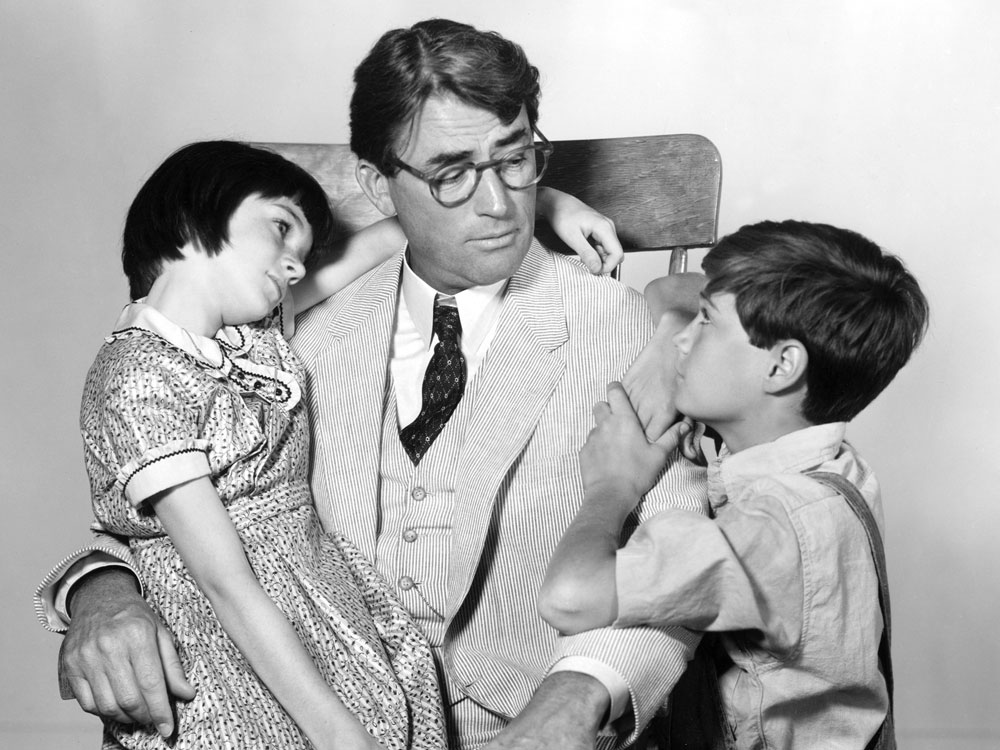
Atticus Finch from To Kill a Mockingbird.
The first name, and I'm already in tears.
It is a sin to kill a mockingbird. Mockingbirds don’t
do one thing but make music for us to enjoy.
This story is so painful and so beautiful that has me in tears every time. Atticus Finch is the widowed father of Scout and Jem. A lawyer who defends a black man in the 1930s., defends him despite the racism of the time, despite the threats against is family, and despite becoming a "nigger-lover." Atticus is also reprimanded by his sister for the way he raises up his children, especially his daughter Scout, who's a free spirit, rebellious, and as unprejudiced as her father. If, for some reason, the reader doesn't fall in love with the Atticus who speaks justice from the pages of Harper Lee's masterpiece, they have no means of escape the moment Gregory Peck appears on screen, exuding humbleness, sorrow, justice, and just incredible acting.
 Goriot from Le Pere Goriot.
Oh
dear, where do I start? Goriot has to be the most dejected father
figure in fiction. Drove himself to bankruptcy to support his two
daughters, only to be neglected by both. Set in a post-Napoleonic era,
the story of Father Goriot is of love, sacrifice, poverty and greed. Old
Goriot, who has once prospered making vermicelli, lives now in a
boarding house and continues to dot upon his two daughters, both of them
married and living in high society. Devoting his life, love, time and
money to his daughters, Delphine and Anastasie, Father Goriot didn't
even suspect those two ungrateful leeches would continue sucking his
blood even after being married into prosperity and wealth. Delphine has
sold her mother-in-law's jewels for the debts of her lover, Anastasie is
always short of money, and who has to pull them out of misery? Of
course their poor, now sick father, who has to sell the buckles of his
shoes to support them. And do they visit him on his deathbed? Or at
least his funeral? Pere Goriot is the quintessence of tragedy and
sacrifice, and Charles Aznavour's heartbreaking performance makes you want
to cross the screen and plant a tender
kiss on that old, wrinkled brow.

I've recently watched this movie and was totally blown away by the amount of sweetness and the incredible characters. Ramona's dad, Robert Quimby (portrayed by John Corbett) has to be one of the best dads in fiction. I had never witnessed such a wonderful, heartwarming, loving relationship between a father and a daughter. Bob always finds time for his daughters, even when he's frustrated with losing his job and the possibility of losing their house. He's a kind, loving, caring father, and he's probably one of the reasons that Ramona is the way she is: funny, dreaming and adventurous. And the enormous painting that Robert and Ramona make at the end of the movie is the reflection of the big love they feel for each other. Such a pity I had never heard of the books before, but now they're on my TBR list.

Mufasa from The Lion King.
Who doesn't remember Mufasa, the great king of the Pride Lands? Who didn't cry during one of the saddest scenes in the history of cinema? Who didn't shed tears when Mufasa's spirit talked to Simba and told him to take his place in the Circle of Life? Mufasa has to be one of the best Disney dads: he's just, fair, honorable, righteous... a true king and just a great dad who finds time to play with his son and teaches him the lessons of life, the most important of them being the balance of the Circle of Life and the respect toward each other. I've always liked Mufasa's wife too, Queen Sarabi, but I'll leave her character for the Mother's Day.

Remember Lizzy Bennet's dad? Mr. Bennet, the tired husband of indefatigable and querulous Mrs. Bennet, hiding in his study most of the time, sheltering himself from his family's troubles and his wife's nagging. Maybe not the best father in fiction, but one of the most notable ones. Perhaps if Mr. Bennet had paid more attention to his family, especially the youngest daughters, the Bennets wouldn't face so many troubles and a possible disgrace in a 19th century England, but the readers forgive him his negligence the moment he speaks his famous line, "An unhappy alternative is before you, Elizabeth. From this day you
must be a stranger to one of your parents. Your mother will never see
you again if you do not marry Mr. Collins, and I will never see you again if you do." This line, followed with Mrs. Bennet's squeal, has to be one of the funniest scenes in the BBC's wonderful adaptation with too-handsome-for-words Colin Firth as Mr. Darcy. But because we're celebrating Father's Day, I shouldn't bypass Benjamin Whitrow, who portrayed Mr. Bennet. A wonderful performance from a wonderful actor.

This is probably the only time when I consider the daughter not worthy of the father. Indeed, I dislike Ariel a lot. A bratty 16-year-old, led by sudden impulses and caprices, mischievous, naughty, deaf to any reasoning, unruly and disobedient. I can't recall a single time when Triton was unjust to her, yet Ariel behaves as if her father is a tyrant when all he wants is to protect his daughters from the dangers under and above the sea. He does let his anger loose and destroys her collection of human artifacts, but let's be honest, the man was tired of chasing his teen daughter across the endless ocean, and trying to reason with her, at the same time ruling a whole underwater kingdom. Besides, she had disobeyed him for the umpteenth time. And as if it was not enough, the bratty princess causes so much trouble, almost gets the kingdom destroyed and her father killed (who sacrifices his life for her ungrateful self). And of course Triton, a great father that he was, not only forgives her, but bestows her with the gift she desired the most: legs and a chance to get married at 17, abandon her family and go live with the hot guy she barely knew and those who hunt her family and friends. A wonderful father, a rotten child.

Goosebumps! The Shining is easily one of Stephen King's best horrors. Sent to Overlook Hotel for the winter, writer and concurrently an alcoholic Jack Torrance slowly declines into insanity, and the old ghosts of Overlook do not seem to mind him joining their demented company. As if the book is not scary enough, Jack Nicholson is here to creep us out with his famous "Heeere's Johnny!" as he smashes the door to the bathroom with an axe.
One might wonder what happens to Danny Torrance, Jack's little son, after witnessing his cracked father chase him and his mom with an axe across the empty (apart from the dwellers that never leave) hotel. Well, S.K. gave us the answer in the sequel, Dr. Sleep. My opinion of the sequel: Do not bother. Boring, tedious, and not a bit scary. I mean, not a single bit scary!

The 6000-year-old immortal elf was not only Arwen's father, but also a father figure for Aragorn, the true king of Gondor. A descendant of the Maiar, the Lord of Rivendell is wise, righteous, courageous, and stays in the Middle-Earth until the evil is destroyed. Although elves do not show their emotions the way we, the humans, do, Elrond's love and suffering is unquestionable. He'd rather his daughter came with him to Valinor, but he doesn't domineer over her life and doesn't rebuke her for loving a mortal man. Elrond's just too wise to do that: his great-grandmother Luthien once had made a similar choice.

Alright, I love Faramir. He's my most favorite fantasy character. And I detest anyone who wants to hurt him. So it's obvious that Denethor is not my favorite guy. The way he treats Faramir, his youngest, makes me want to choke him while he chomps on the beef. Denethor was a stronger character in the books; in the movie he's too unlikable, portrayed as weak and cowardly. So I don't necessarily hate the book Denethor. Also, Gandalf's description of Gondor's steward is flattering in The Return of the King: "He has long sight. He can perceive, if he bends his will thither, much
of what is passing in the minds of men, even of those that dwell far
off. It is difficult to deceive him, and dangerous to try." I wouldn't mind serving to this type of a ruler, but I'd think twice before asking for a father like the movie Denethor. Trying to burn your half-dead son on a pyre while committing suicide is not fatherly.

Kyle Reese and the Terminator from The Terminator and The Terminator 2: Judgement Day.
I decided to discuss both characters simultaneously. The first one, being a human, conceived John Connor, the savior of the mankind, and the second one, a machine, was the only father figure John got to know.
 Saying that Kyle Reese only conceived John Connor is actually a harsh understatement. He traveled back in time to save Sarah Connor from a robot that "is out there, can't be bargained with, can't be
reasoned with, doesn't feel pity, or remorse, or fear. And it
absolutely will not stop." Of course while saving Sarah, Kyle
doesn't forget to conceive Johnny, and thank God he was so handsome that
she couldn't resist (even though she had known him for just a few
hours), otherwise mankind would be doomed.
Saying that Kyle Reese only conceived John Connor is actually a harsh understatement. He traveled back in time to save Sarah Connor from a robot that "is out there, can't be bargained with, can't be
reasoned with, doesn't feel pity, or remorse, or fear. And it
absolutely will not stop." Of course while saving Sarah, Kyle
doesn't forget to conceive Johnny, and thank God he was so handsome that
she couldn't resist (even though she had known him for just a few
hours), otherwise mankind would be doomed.
Now the Terminator from the Judgement Day. Same face, different machine. A machine that realizes the value of the human life while we still don't give a damn about each other. A machine that "would never stop, would never leave [John], would
never hurt him, never shout at him, or get drunk and hit him, or say it
was too busy to spend time with him. It would always be there. And it
would die to protect him. Of all the would-be fathers who came and went
over the years, this thing, this machine was the only one that measured
up. In an insane world, it was the sanest choice."
p.s. The Terminator, one of the most famous sci-fi movies, is also easily one of the greatest love stories ever told.

Guido from Life is Beautiful.
How to survive in a concentration camp and not even realize you are in one? You need a father like Guido.
This movie is a masterpiece. I have watched it only once and don't think I'll be able to watch it ever again. Too painful. And it's not just about the sacrifice, but how that sacrifice is accomplished. In the end you can't help but feel Guido's exhaustion caused not only from surviving in the concentration camp, but from applying so much energy to conceal the truth from his little son Joshua. Talking, joking, lying, making things up, twisting the truth, everything for the sake of a child who didn't deserve the hell called fascism. It's one of those movies when you can't help telling the characters: "Hold on just a little bit more, help is coming." And Guido, with his resource and quick wit and love for life, is the kind of person who will not stop. Throw him down, and he'll get up, cut his legs, and he will crawl, but if he's still breathing, then he won't stop.

Marlin from Finding Nemo.
Now this dad went to hell and back to find his son Nemo, who had been kidnapped by people who think that smaller creatures have no feelings but are created for their own amusement. Finding Nemo is one of the best cartoons of the 21st century: vivid, adventurous, with a strong message, and some of the funniest characters. Who doesn't love Dory? I admit she irks me a bit, but she plays an important part in finding Nemo.
Marlin is a great father. Overprotective, but he can't be otherwise, considering what has happened to his wife and the rest of their unborn fish-kids. He's probably the most active Disney dad (I know it's a Pixar movie, but Disney is involved, too). While Ariel's, Jasmin's, Belle's, Mulan's fathers play major roles in the lives of their daughters, all of them are secondary characters. But Marlin is the star of the movie, crossing the ocean, escaping wannabe-vegetarian sharks and jellyfish, traveling inside a whale, all the while looking for a needle in a haystack. One of the most loving and brave fictional dads.
I am sure I have missed lots of fictional great dads, so feel free to add some in the comments section.
Happy Father's Day!


